We Fight for a Fair Economy & Fair Elections

Multi Party Election Reform
Star Voting


STAR - Score Then Automatic Runoff
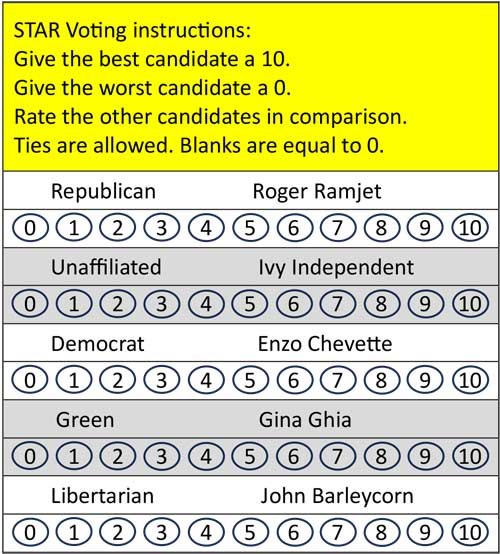
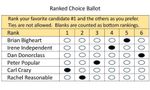
It's easy! Score the best candidate a 10, the worst 0, and the other candidates in comparison. Ties are allowed, 5 is the middle score.
The two candidates with the highest total scores meet in an automatic runoff that elects a majority winner.
Counting the Votes
In the automatic runoff, the candidate preferred on most ballots wins. If Ivy Independent and Roger Ramjet are the finalists, and you gave Ivy a score of 5 and Roger a 3, your vote would go to Ivy. If you gave both candidates a 4, your vote will not help or harm either candidate because you have no preference between them.
The score range could be 0 - to any even number. A score range from “0” to an even number top score will have a middle score. A 0 to 6 range would have 3 as a middle score. Ideally, the score range should exceed the number of candidates, so voters do not need to have ties on their ballots.
Strategy
STAR encourages voters to vote sincerely; you can give high scores to your favorite candidates and low scores to the candidates you oppose. In the runoff, it does not matter if you gave the candidates 10 & 0 or 6 & 5; your preferred candidate gets 1 vote.
Strategic voting may backfire. If you give one candidate a top score and everyone else 0, you have no voice if your favorite does not make the automatic runoff. You could also give all the candidates you like a top score and those you dislike a 0, but this could help your second or third choice at the expense of your favorite. This would also put your worst candidate on par with the candidates you dislike less.
State Constitutions
In STAR’s automatic runoff, the candidate preferred by a majority of the voters wins. This will satisfy state constitutions that require the “highest,” “greatest,” or “largest” number of votes, a “plurality” of the votes or a “majority” of the votes IF the state supreme court agrees that each voter’s preference in the Automatic Runoff is their vote. A court might reject the method STAR uses to choose the two finalists.
Implementing any voting method that the state supreme court rules unconstitutional would require a state constitutional amendment.
Additional Considerations
STAR is a hybrid voting method designed to be neutral. STAR has no preference towards the middle or the extremes.
STAR topped the charts in VSE (Voter Satisfaction Efficiency). So much so that Jonathan Quinn, the creator of VSE, recommended STAR Voting.[1] Both STAR and Score were well above “choose 1” Plurality voting and Ranked Choice Voting. The VSE study did not include BTR-Score.
It is more work to count STAR ballots than plurality ballots. Opponents will scream bloody murder, but it is not a big deal. Many nations have far more complex voting systems.
STAR will elect a winner in a fair manner. STAR’s simplicity makes it a transparent voting method. Ranked Choice Voting is more complex than STAR, and less reliable because not all RCV “second choice” votes are counted.
STAR voting will enable voters to express their true opinions about each candidate without fear of spoilers. This makes STAR voting far better than traditional Plurality voting.
Summery
STAR voting is superior to Plurality voting and Ranked Choice Voting. We consider it to be one of the three best voting methods for single-winner elections, along with BTR-Score and Roud Robin voting.
Featured Articles

Goals
Aug 15, 2026

Make Capitalism Work for the People
Jul 07, 2026
Round Robin Voting Methods for Fair Elections
Jun 26, 2026

Consensus Choice Voting System
Apr 16, 2026

Top Four and Final Five Blanket Primaries
Apr 08, 2026

Eliminate Citizens United
Apr 05, 2026

How the Billionaire Coalition Wins
Mar 24, 2026

The Montana Plan to Stop Corporate Campaign Spending
Dec 13, 2025

The Second Law of Economics
Dec 02, 2025

Chinese Style Surveillance in America
Dec 01, 2025

A Graduated Corporate Tax to Increase Competition
Nov 29, 2025
BTR-Score Voting
Oct 16, 2025
Approval Voting and Combined Approval Voting
Oct 14, 2025

NOPWSIcare - Great Healthcare & More Jobs
Sep 01, 2025


The Tax Code Is a Con and You're the Mark
Aug 25, 2025

Plurality Voting Pros and Cons
Aug 20, 2025

Why America Needs Proportional Representation
Aug 16, 2025

Building Capitalism for the People
Jul 13, 2025