We Fight for a Fair Economy & Fair Elections

Multi Party Election Reform
Neutral Open Primaries: A Real Fix for a Rigged System
Three Primary Problems
1 - Most districts and states are safe for one of the major parties. Small sets of partisan primary voters decide each race before the general election.
2 - Major parties gain publicity as their nominees sail onto the November ballot with the momentum of victory and a pulse of campaign cash. Third parties miss the publicity, the victories, and the money. Instead, they must petition onto the ballot.
3 - Low turnout. Neutral Open Primaries will give voters actual choices. A greater variety of candidates will make primary elections more interesting.
Neutral Open Primary
A Neutral Open Primary is a blanket primary (aka jungle primary) that includes the nominees of all political parties and all unaffiliated candidates. Three to five candidates advance to the general election. A fair and competitive all-candidate primary will increase voter turnout.
Parties select their nominees as they see fit. Party nominees are identified on the primary ballot. Candidates who compete for a party nomination and lose are not eligible to run in a Neutral Open Primary. A traditional party primary could precede a Neutral Open Primary, but that would create a three-round election.
Major parties will try to exclude third parties by setting difficult qualifications for political party status. For fair elections, we cannot allow this.
Independent candidates will be required to petition onto the ballot because they lack the qualifications and responsibilities of a political party.
Voting in a Neutral Open Primary
Plurality voting is better suited for blanket primaries than single-winner elections. Voters will nominate candidates with distinct platforms.
Voters will face an interesting decision. Should you vote for your favorite candidate without regard to how others might vote, or do you vote for your second choice who is in a tight race to be the last finalist? Or do you vote to make sure an acceptable major party candidate makes the final round?
A voting method that allows voters to support multiple candidates could enable a well-organized faction to win all the spots in the final election by block voting.
BTR-Score for the Final Round
BTR-Score is far superior to plurality voting and more reliable than Ranked Choice Voting.
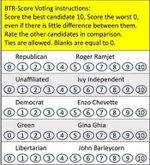
BTR-Score is easy; give your favorite candidate a ten, the worst a zero. Rate the other candidates in comparison. Ties are allowed.
Each candidate’s total score seeds a single-elimination Bottom Two Runoff tournament. The top seed goes to the candidate with the highest total score; the candidate with the lowest total score is the bottom seed.
The two lowest seeds meet in the first contest of the tournament; the candidate preferred on most ballots wins. That winner meets the next-lowest seed in the second contest. This continues until the survivor meets the top seed to determine the election winner.
If you give candidate Bob a score of 4 and candidate Carl a score of 2, your vote will go to Bob when they meet in the tournament. If you score them equally, your vote will not help nor harm either candidate.
Candidates will have a powerful incentive to appeal to a wide audience. Voters may punish divisive candidates with low scores. Election campaigns will calm down.
Because every candidate competes in the BTR tournament and every contest in the tournament is a two-person plurality vote with a majority winner, the BTR-Score tournament should comply with state constitutions that call for election winners to have the “highest”, “largest” or “greatest” number of votes, or a “plurality” or “majority” of the votes.
Condorcet Voting
Condorcet voting methods like BTR-Score will always elect the candidate who “beats all” other candidates one-on-one. In the unusual race without a “beats all” candidate, BTR-Score will elect a deserving winner, the winner of the single-elimination tournament. Ramon Llull discovered the “beats all” concept in 1299. The Marquis de Condorcet popularized it in the late 18th century.
Two Party Rule is Locked In
We rarely cast votes for third party and independent candidates because doing so could help the major party candidates we oppose. Support for third parties and independents is always under reported. This harms third party efforts to recruit members, generate publicity, and raise funds.
Third party members and independents are dissuaded from running for office because plurality voting has rigged the system against them. Petition signature requirements and filing fees are minor problems in comparison.
To fix the system, primary elections must be fair to all candidates and parties, and plurality voting must be replaced with a better method like BTR-Score.
Nonpartisan Elections?
Our current system is rigged in favor of the major parties by excluding most third parties from the primary elections. Nonpartisan elections favor independent candidates and hide third parties by failing to identify party nominees on the primary and general election ballots.
The Problem with Independent Candidates
Nobody pays attention to independent candidates unless they have money. A better election system will help, but it will not solve the problem. Most wealthy candidates are loyal to their economic class after they are elected.
The engine of capitalism, fraction reserve banking, can generate plenty of capital from middle class savings unless allow the rich to hoard all the wealth. Capitalism gave farmers, tradespeople, and merchants greater access to financial capital. They used it to create other forms of capital including tools, machines, buildings and technology. In a capitalist economy, there is no need nor reason to favor the wealthy.
A Fair Chance for Third Parties
Neutral Open Primaries will give third parties an opportunity to appeal to voters in a high-profile, all-candidate primary election where they have a fair chance to advance to the final.
Our third parties are not small because voters are satisfied with the major parties; they are small because voters fear spoilers. To avoid electing a major party candidate we detest, we will vote for a mediocre major party candidate instead of a good third-party or independent candidate.
To break the current dysfunctional duopoly of power, we need Neutral Open Primaries and better voting methods like BTR-Score for single-winner elections. Two parties are not enough to represent the American people.
Benefits of Neutral Open Primaries
A Stronger Voice for Voters
In a Neutral Open Primary, all voters participate in choosing the candidates for the general election ballot. You can vote for a party nominee or an unaffiliated candidate. You can rate every candidate in a BTR-Score final.
Incentives for Parties
A Neutral Open Primary followed by a BTR-Score general election will create a powerful incentive for parties to nominate candidates with broad appeal.
A Better Voting System
Our current system locks in two-parties that cannot work together. Unlike traditional elections, the combination of a Neutral Open Primary and a BTR-Score final is fair to all parties and candidates. Voters will be in charge.
Featured Articles

Star Voting
Aug 19, 2026

Goals
Aug 15, 2026

Make Capitalism Work for the People
Jul 07, 2026
Round Robin Voting Methods for Fair Elections
Jun 26, 2026

Consensus Choice Voting System
Apr 16, 2026

Top Four and Final Five Blanket Primaries
Apr 08, 2026

Eliminate Citizens United
Apr 05, 2026

How the Billionaire Coalition Wins
Mar 24, 2026

The Montana Plan to Stop Corporate Campaign Spending
Dec 13, 2025

The Second Law of Economics
Dec 02, 2025

Chinese Style Surveillance in America
Dec 01, 2025

A Graduated Corporate Tax to Increase Competition
Nov 29, 2025
BTR-Score Voting
Oct 16, 2025
Approval Voting and Combined Approval Voting
Oct 14, 2025

NOPWSIcare - Great Healthcare & More Jobs
Sep 01, 2025

The Tax Code Is a Con and You're the Mark
Aug 25, 2025

Plurality Voting Pros and Cons
Aug 20, 2025

Why America Needs Proportional Representation
Aug 16, 2025

Building Capitalism for the People
Jul 13, 2025