We Fight for a Fair Economy & Fair Elections

Multi Party Election Reform
Consensus Choice Voting System


Better Choices for Democracy offers Consensus Choice as an alternative to traditional primary elections and plurality voting.
Former US Senator Joe Manchin of West Virginia is a key backer. Nicolaus Tidman, the creator of BTR-Score voting and several other voting methods, is on the Better Choices board of directors.
1st Round - Open Blanket Primary
Consensus Choice starts with an open blanket primary election that advances four or five candidates to the second round. Suspiciously, the Better Choices website gives little detail about this primary.
The current primary system favors the major parties and excludes others. Some states offer "open" or "semi-open" primaries. Voters who are not party members help select party nominees. This is unfair to the parties, and perhaps unconstitutional.
The justification for open primaries is the duopoly of power enjoyed by the Democratic and Republican parties. Also, most seats are safe for the dominate party in each district; the primaries determine the outcome of those elections. Taxpayers fund the primaries; therefore, all voters should be able to vote in them.
For a blanket primary fair to all candidates; check out our Neutral Open Primaries proposal. A blanket primary can also be designed to favor wealthy and well-financed independent candidates like the Top Four and Final Five Primaries.
2nd Round - Ranked Robin Voting Method
A Ranked Robin (aka Ranked Pairs) voting method is used for the final vote. Ranked Robin methods will elect the candidate who defeats every other candidate one-on-one, provided that a "beats all" winner exists. Voting methods that elect the "beats all" winner when one exists are known as Condorcet methods. The "beats all" candidate is known as the Condorcet winner.
Like BTR-Score voting, Ranked Robin is an easy-to-understand that offers Condorcet fairness and reliability.
How it works
Open Primary - Candidates from all parties compete in an open blanket primary. Four or five candidates advance to the general election. The rules for this primary election have not been specified by Better Choices for Democracy, the proponents of Consensus Choice.
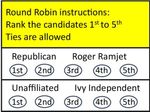
Ranked Robin final - Voters rank all the candidates who advanced from the open primary. Ties may or may not be allowed.
Ballot Tabulations - Candidates are compared head-to-head, like a round-robin tournament. Wins and losses for each pair of candidates are determined from each ballot. If you ranked Aaron 3rd and Beth 4th, your vote goes to Aaron when they meet in the tournament.
The results from all the ballots determine who wins each one-on-one match in the round-robin tournament. If a candidate beats all the other candidates one-on-one, that candidate wins. If there is no “beats all” winner, the candidate with the most wins is elected.
Most Wins, Smallest Loss tiebreaker - In case of a tie, the candidate with the smallest head-to-head loss versus all other candidates wins. Thus, the candidate closest to a Condorcet win is elected. The tiebreaker is the chief difference between the various Ranked Robin methods.
State Constitutional Compliance
The Better Choices for Democracy site does not discuss compliance with the forty state constitutions that require election winners to have the “largest,” “greatest,” or “highest” number of votes or a “plurality of the votes”. The round robin tournament, the “smallest loss” tiebreaker, and the unspecified primary must comply. If not, an amendment to the state constitution would be required to enact Consensus Choice.
Recommendation?
We need to see the open primary details to determine if Consensus Choice is worthy of use in American elections.
Featured Articles

Star Voting
Aug 19, 2026

Goals
Aug 15, 2026

Make Capitalism Work for the People
Jul 07, 2026
Round Robin Voting Methods for Fair Elections
Jun 26, 2026

Top Four and Final Five Blanket Primaries
Apr 08, 2026

Eliminate Citizens United
Apr 05, 2026

How the Billionaire Coalition Wins
Mar 24, 2026

The Montana Plan to Stop Corporate Campaign Spending
Dec 13, 2025

The Second Law of Economics
Dec 02, 2025

Chinese Style Surveillance in America
Dec 01, 2025

A Graduated Corporate Tax to Increase Competition
Nov 29, 2025
BTR-Score Voting
Oct 16, 2025
Approval Voting and Combined Approval Voting
Oct 14, 2025

NOPWSIcare - Great Healthcare & More Jobs
Sep 01, 2025


The Tax Code Is a Con and You're the Mark
Aug 25, 2025

Plurality Voting Pros and Cons
Aug 20, 2025

Why America Needs Proportional Representation
Aug 16, 2025

Building Capitalism for the People
Jul 13, 2025