We Fight for a Fair Economy & Fair Elections

Goals


Two Splendid and Doable Opportunities
Better Voting Methods for Fair elections
The Montana Plan to Stop Corporate Campaign Spending
We can make a huge difference!
Better Voting Methods
Plurality Voting and Ranked Choice Voting are not good enough for America
Traditional choose one plurality voting is unfair to voters, third-parties, and independent candidates. It has fatal problems:
You can only rank one candidate as better than the other candidates. Your vote for a third party or independent candidate, will cause your preferred major party candidate to lose your vote. This will help the major party candidate you dislike. Because voters fear wasting their votes, independent and third party candidates do not have a fair chance. Two party rule is locked in.
Because we can only vote for one candidate, support for third party and independent candidates is under reported in every election. This harms third party efforts to recruit members and candidates, raise funds, generate publicity, and win elections.
For these reasons, social choice experts rank plurality voting at the bottom of the heap. Only random choice and dictatorship are lower.
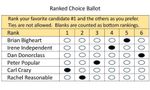
Ranked Choice Voting (RCV) allows you to rank every candidate. It is a major improvement over plurality voting, but RCV is susceptible to spoilers. Sarah Palin, through no fault of her own, spoiled the chances of fellow Republican Nick Begich, electing Democrat Mary Peltola in a 2022 congressional election. The ballots clearly showed that Begich would have beaten both Peltola and Palin one on one. Eventually, a Democrat will lose an RCV election in the same manner.
Star Voting
Star voting is simple and fair. Score the best candidate 10, the worst 0, score the other candidates in comparison. Ties are allowed. The two candidates with the higest total scores meet in an a one-on-one instant runoff to elect a majority winner.
Star voting allows you to support more than one candidate. You can express your opinion on all thecandidates. For each possible pair of candidates in an election, your "score" ballot will show which of the two candidates you prefer and by how much you prefer them. You will have a much more powerful voice.
Round Robin
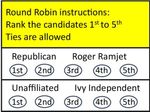
You can rank all the candidates in a Round Robin election, ties are allowed. All candidates face each other one-on-one in an "instant" round robin tournament. If you ranked Ivy Independent second and Gary Green third, you vote would go to Ivy when they meet in the tournament. All the information on everyone's ballot is used. Like Star voting, you can express your opinion on every candidate.
The candidate with the best record in the tournament wins the election. Most elections, especially with more than 5,000 voters, will have an undefeated winner, but ties are possible. We list a number of tie braking methods on our Round Robin page.
BTR-Score
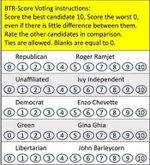
BTR-Score lets you rate each candidate. Like Star voting, score your favorite candidate 10, the worst candidate 0. Score the other candidates in comparison. Ties are allowed. Each candidate’s total score is determined. An instant runoff tournament is seeded with the scores. The highest total score earns the top seed; the candidate with the lowest score is the bottom seed.
In the tournament’s first contest, the candidates with the two lowest scores compete. The candidate preferred on most ballots wins. In the next contest, that winner goes against the next lowest candidate. This continues until a surviving candidate meets the highest seed; that contest elects a majority winner.
If you rated Ivy Independent a 7, and Gary Green a 3, your vote will go to Ivy when they meet in the tournament. If you gave Ivy and Gary equal scores, your vote does not help or harm either candidate.
Condorcet Voting Methods
Round Robin and BTR-Score (Score Voting with a Bottom Two Runoff) have all the advantages of Ranked Choice Voting, but they not susceptible to spoilers.
As Condorcet methods, Round Robin and BTR-Score will always elect the candidate who can beat all other candidates one-on-one. In the rare election with no “beats all” winner, a tie braker will elect a deserving winner. Ramon Llull proposed the “beats all” concept in 1299. Nicolas Caritat, the Marquis de Condorcet, popularized “beats all” methods in the late 18th century.
Fair & Reliable Condorcet Methods
Because Round Robin and BTR-Score are Condorcet methods, we know exactly what they will do; they need no additional testing. The only problem with Round Robin voting and BTR-Score is that nobody knows about them.
Defenders of the status quo will say that we cannot use Condorcet voting in American elections because Condorcet voting has not been used American elections. They support plurality voting because it's flaws protect the two dominate parties.
Our Goal
Persuede State and local governments to use Star, Round Robin, or BTR-Score in their elections. We want to introduce these methods to America.
Our Target – Denver Colorado
Why Denver? On Monday, August 11th, 2025, the Denver City Council came within one vote of passing an ordinance that would have put Ranked Choice Voting to a vote of the citizens of Denver. Star, Round Robin, and BTR-Score voting are all at least one vote better than RCV.
This is doable! We have an opportunity to improve democracy in Denver and America. Denver is a world-famous city that is our home. A victory in Denver will put a better voting voting system on the national map. We need members in Denver to contact their representatives on the city council in the new year.
the Montana Plan to Stop Corporate Campaign Spending
The Montana Plan will eliminate the power corporations currently have to make campaign contributions.
State governments create corporations and determine what powers corporations have. This is well established by case law.[1] Under current law, most states, including Montana, give corporations the same powers as individual persons. Corporate officers also enjoy corporate immunity; this places corporations above natural persons.
The Montana Plan, also called the Transparent Election Initiative (TEI) will eliminate the power of any corporation, including out-of-state corporations, to spend money in Montana politics, including state, local and federal elections.
The Citizens United Supreme Court decision gave corporations the right to make campaign contributions, but it did not give them the power to do so. Only state governments can grant powers to corporations. The states can limit those powers as they see fit. The Montana Plan does not cancel or reverse Citizens United; it makes Citizens United irrelevant in Montana.
To learn the legal details of how this can be done, please read the annotated version of the TEI initiative. It is clear, concise and revolutionary.
The Montana Plan is Going Viral
People have been waiting for this opportunity since the 2010 Citizens United decision. Colorado Attorney General Phil Weiser (a leading candidate for governor) stated in a Denver Post op-ed “Colorado should join Montana and advance a similar concept to change Colorado law.”
Our role is to contact our state legislators and encourage them to support a “Montana Plan” for Colorado and other states.
The Voters’ Army has an exciting future. We can make a difference and you can help just by sending messages to your elected representatives.
Send messages about BTR-Score and/or Round Robin voting to your elected representatives. Especially Denver City Council members.
Send messages about the Montana Plan to your elected representatives. Especially Colorado State Representatives and Senators.
States’ Rights vs. Corporate Rights, Vincent S.J. Buccola (2016) ↩︎
Featured Articles

Star Voting
Aug 19, 2026

Make Capitalism Work for the People
Jul 07, 2026
Round Robin Voting Methods for Fair Elections
Jun 26, 2026

Consensus Choice Voting System
Apr 16, 2026

Top Four and Final Five Blanket Primaries
Apr 08, 2026

Eliminate Citizens United
Apr 05, 2026

How the Billionaire Coalition Wins
Mar 24, 2026

The Montana Plan to Stop Corporate Campaign Spending
Dec 13, 2025

The Second Law of Economics
Dec 02, 2025

Chinese Style Surveillance in America
Dec 01, 2025

A Graduated Corporate Tax to Increase Competition
Nov 29, 2025
BTR-Score Voting
Oct 16, 2025
Approval Voting and Combined Approval Voting
Oct 14, 2025

NOPWSIcare - Great Healthcare & More Jobs
Sep 01, 2025


The Tax Code Is a Con and You're the Mark
Aug 25, 2025

Plurality Voting Pros and Cons
Aug 20, 2025

Why America Needs Proportional Representation
Aug 16, 2025

Building Capitalism for the People
Jul 13, 2025