We Fight for a Fair Economy & Fair Elections

Multi Party Election Reform
BTR-Score Voting
BTR-Score Voting is Easy
A New Version of an Ancient Method
BTR-Score vs Other Voting Methods
BTR-Score Voting is Easy
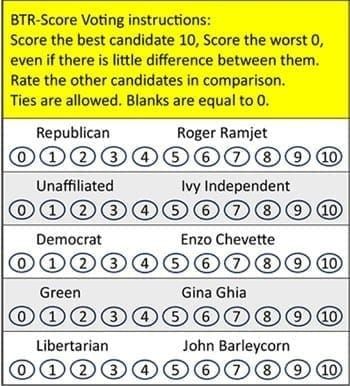
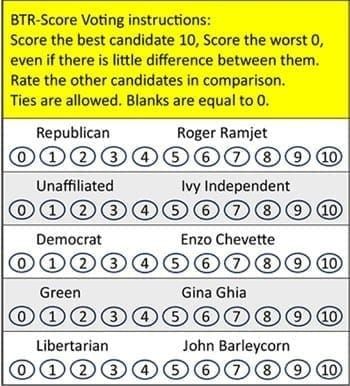
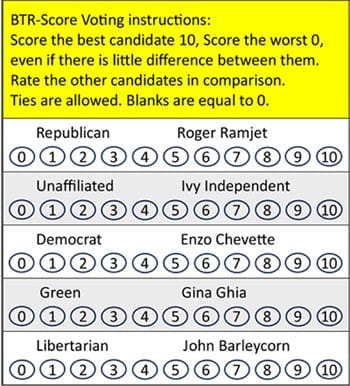
BTR-Score (Score voting with a Bottom Two Runoff) lets you rate each candidate. Give your favorite candidate a 10 and the worst candidate a zero. Rate the other candidates in comparison. Ties are allowed.
Each candidate’s total score is determined. The scores seed the BTR tournament. The highest total score earns the top seed; the candidate with the lowest score is the bottom seed.
In the BTR tournament’s first contest, the candidates with the two lowest scores compete. The candidate preferred on most ballots wins. In the next contest, the winner goes against the next lowest candidate. This continues until the surviving candidate meets the highest seed; the winner is elected.
If you rate candidates Amy a 7 and Bob a 3, your vote will go to Amy when Amy and Bob meet in the tournament. If you rate Amy and Bob equally, your vote does not help or harm either candidate.
Power to the Voters
We can express our opinions about every candidate in BTR-Score races. In our current elections, we can only rank one candidate as better than the others. BTR-Score election results reveal the voters’ true intentions. We no longer have to vote for the lesser of two evils.
A True Voice for Third Parties
Because we rarely vote for third party candidates; third party support is under reported in every plurality election. This harms their efforts to recruit members, generate publicity, raise funds, and win elections. BTR-Score elections are fair to all candidates and parties.
Incentives for Good Campaigns
To win a BTR-Score race, candidates must appeal beyond the base. Fear of low rankings will dissuade crude, rude, and divisive campaign rhetoric.
Plurality, and to a lesser extent, Ranked Choice Voting, allow moderate candidates to be squeezed out by more extreme left and right candidates. BTR-Score is neutral. Neutral Open Primaries would also reduce center squeeze.
A New Version of an Ancient Method
Condorcet voting methods like BTR-Score will always elect the candidate who “beats all” the other candidates one-on-one (if such a candidate exists). That candidate is the Condorcet winner.
In the rare election without a “beats all” Condorcet winner, BTR-Score will elect a deserving winner, the champion of the BTR tournament. Also, BTR-Score is simpler than most Condorcet voting methods.
Ramon Llull proposed the “beats all” concept in 1299. Nicolas Caritat, the Marquis de Condorcet, popularized “beats all” methods in the late 18th century.
Imperfections
No voting method is perfect. All single-winner voting methods fail at least a few important voting method criteria.
The Condorcet criterion is incompatible with the Later No Harm criterion. Later No Harm posits that a voter giving an additional ranking or positive rating to a less-preferred candidate should not cause a higher ranked (or rated) candidate on that voter's ballot to lose.[1] Most voting methods fail the Later No Harm criterion. Methods that pass Favorite Betrayal fail the Condorcet criterion.
Condorcet methods are also incompatible with the Favorite Betrayal criterion. This issue arises solely in a rare contest that lacks a Condorcet winner, and even then, only sporadically. Favorite Betrayal holds that voters should have no incentive to vote for someone else over their favorite. If there is no Condorcet winner, a strategic vote to support a “lessor evil” candidate over your true favorite might be effective. You would need near-perfect knowledge of how other voters will vote.
Your best bet in any Condorcet election is to give maximum support to your favorite candidate. Voting methods that comply with the No Favorite Betrayal criterion cannot pass the Condorcet criterion.
Losing Candidate Complaints
A losing candidate who beat all the other candidates one-on-one has a good reason to complain. Such a loss will not happen in a Condorcet election.
Plurality and Approval avoid those complaints because their ballots do not have enough information to determine the "beats all" winner in a close race with three or more candidates.
Third parties and independents always have a valid complaint about vote splitting in Plurality races. Approval voting keeps its promise to elect the candidate with the widest support.
RCV vote tabulations reveal Condorcet winners; they will complain when they lose.
State Constitutional Requirements
BTR-Score has a sound argument for compliance with state constitutions that require election winners to have the highest, largest, or greatest number of votes, or a plurality of the votes. The tournament is a series of one-on-one votes. In every tournament contest, every voter has a vote, and the candidate with the highest number of votes wins.
Approval, Ranked Choice, and STAR voting also have good arguments for compliance. If a voting method is rejected by a state supreme court, the state constitution must be amended to implement that voting method.
Fair and Reliable
BTR-Score will always elect the “beats all” winner. Absent a “beats all” winner, it will elect a worthy candidate, the champion of the BTR tournament. This is as fair and reliable as single winner elections get.
BTR-Score is ready for American elections. It is far better than plurality voting and simpler than Ranked Choice Voting (RCV). The capricious way RCV counts some second-choice votes but not others has generated considerable opposition to RCV.
Defenders of the status quo will say that we cannot use BTR-Score in American elections because BTR-Score has not been used in American elections. They support Plurality voting because its flaws protect the dominant party in each state and district.
BTR-Score vs Other Voting Methods
Traditional Plurality Voting
In a plurality race, you often must vote for the lessor of two evils instead of your favorite candidate to avoid helping the major party candidate you detest. Vote splitting is unfair to you and your favorite candidate. BTR-Score enables you to support every candidate you like and diss the ones you don’t like.
BTR-Score is not prone to spoilers except in the rare circumstance described in “Imperfections” above.
Plurality Voting Locks in Two-Party Rule
We seldom vote for independent or third-party candidates for fear of helping the “greater evil candidate”. This locks in two-party rule. Most districts are not competitive; elections are decided by partisans in the primaries. Moderates are squeezed out.
Our two major parties are at war; each election campaign is more hostile. The billionaires control the show. Are you satisfied with our dysfunctional duopoly of power?
Because BTR-Score voters rate all candidates, BTR-Score gives third party and independent candidates a fair chance and a true voice. Plurality favors candidates at the extremes; BTR-Score is neutral.
Plurality Voting is Unreliable
Spoilers threaten every plurality election with three or more candidates. Teddy Roosevelt and William Howard Taft split votes in the 2012 election, allowing Woodrow Wilson to win with less than 42% of the vote. Ralph Nader spoiled Al Gore’s chances in the 2000 election. Robert Kennedy Jr. threatened Biden and Trump in 2024. Trump was smart enough to offer him a job.
Voting system experts rank plurality voting near the bottom of the heap. To learn more, please visit Plurality Voting: Pros and Cons.
Strategy
Plurality voting forces you to make strategic decisions in every election with three or more candidates. A faction can split its opponent’s vote by running a clone candidate with a similar platform.
Because BTR-Score resists strategy, you can sincerely rate all candidates with confidence. In a BTR-Score race, bullet voting (giving your top candidate 10, and all others 0) would harm the chances of your second choice without helping your favorite. No candidate can win the tournament without defeating their strongest rival. An organized strategic campaign would run into the same problem.
Alternative Voting Methods
RCV, Score, Approval, STAR and Ranked Robin voting methods are all superior to Plurality voting.
Ranked Choice Voting aka Instant Runoff Voting
Ranked Choice Voting (RCV) is superior to Plurality, but it’s not good enough; RCV elections occasionally have spoilers. In a 2022 RCV congressional race Sarah Palin, through no fault of her own, spoiled the chances of fellow Republican Nick Begich, allowing Democrat Mary Peltola to win.[2] Begich was the Condorcet winner, he also had the widest support.
Republicans do not trust RCV; Democrats will lose faith in RCV when they lose an important RCV election due to a spoiler. It could happen in 2026 when Mary Peltola runs for the US Senate in a race that could determine control of the Senate.
When RCV elections fail to elect existing Condorcet winners, they will elect candidates with high overall support. Should a candidate with many high ranks and few low ranks win if most voters prefer a different candidate?
RCV ballot tabulations make the failure to elect a “beats all” Condorcet winner painfully obvious. The greater problem may be the cause; RCV counts the second choices some voters but not others. Because those other voters have less say in the election results; RCV might violate the spirit of the one-person-one-vote rule. A “beats all” Condorcet winner who loses an RCV election has good reason to complain.
Why Not Score Voting?
Score voting and BTR-Score use the same ballot. Each voter gives each candidate a score. Each candidate’s total score states their overall utility as measured by the voters. Score voting elects the candidate with the highest total score. However, the voters might choose a different candidate over the score winner in a one-on-one match.
Consider candidate Bob; he has passionate support and high scores from a good number of supporters, but most voters think he is mediocre. Bob has the highest score but loses a one-on-one match to candidate Amy, who most voters rate as above average. Score could give Bob’s ardent supporters a stronger voice than the majority of voters who think Amy is better than Bob.
In America, majority is valued over utility. The Bottom Two Runoff of BTR-Score voting favors majority over utility. Amy defeats Bob in the BTR tournament, and she wins the election if she beats all the other candidates.
Score voting also encourages strategic voting. Voters could bullet vote, giving their favorite the highest score and the other candidates a 0. A voting method should encourage voters to vote sincerely. A bullet vote is sincere only if the voter loves one candidate and hates the other candidates. An organized bullet voting campaign could be effective.
Range Voting
Range voting[3] is a sophisticated version of Score voting. It has a “No Opinion” option for voters who are unfamiliar with a candidate(s). A candidate’s total score is divided by the number of voters who expressed an opinion about that candidate. The candidate with the highest average wins. Strategic bullet voting campaigns are still a threat.
Score and Range voting are clone proof. A faction cannot split an opponent’s vote by running a clone candidate with a platform similar to the opponent’s platform. A clone candidate can be used to rig a plurality election.
Some states may require a constitutional amendment to impliment Score voting because scores are not equivalent to votes.
Approval Voting
Approval voting has performed well in many settings. It rewards candidates who have broad support; creating a powerful incentive to reach out to all voters and avoid divisive rhetoric.
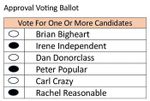
Approval is not as expressive as BTR-Score; it limits voters to either approving or rejecting each candidate. Instead, Approval voting asks one basic question: “Do you approve of this candidate or not?” With this question, Approval elects the candidate with the widest support.
Students of social choice consider approval voting among the most reliable voting methods because it complies with as many or more voting method criterium than any other voting method.
Approval ballots do not accurately reveal a Condorcet winner, perhaps avoiding criticism for failures to elect Condorcet winners.
STAR Voting - Score Than Automatic Runoff
STAR voting (Score Then Automatic Runoff) starts with a Score vote. The two candidates with the highest scores compete in an automatic runoff that elects the winner. The runoff gives STAR more resistance to strategic voting than Score voting.
STAR complies with most state constitutions; some STAR supporters claim that it is constitutional in all states. All voters who favored one of the two candidates will have their votes counted in the automatic runoff. The two-person runoff has a majority winner. BTR-Score uses a similar argument: all voters will have their votes counted in every BTR tournament match. Every match has a majority winner.
In the unusual event that STAR does not elect an existing “beats all” winner, it will, in most races, elect the candidate with the highest score. Losing STAR candidates would need a review of the ballot data to determine if they were the “beats all” Condorcet winner. However, STAR does not promise to elect the Condorcet winner.
Star is one of the best single winner election methods. To learn more about STAR please visit the Equal Vote Coalition.
Ranked Robin Methods
Ranked Robin is a descriptive name for a class of Condorcet voting methods that compare all candidates against each other. A Ranked Robin election has a round-robin tournament with contests between each pair of candidates.
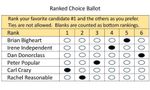
Voters rank each candidate first to last; your ballot shows which candidate you prefer in every possible one-on-one match. If you rank candidate Amy third and candidate Bob fourth, your vote goes to Amy when Amy and Bob meet in the round-robin tournament.
Most, but not all versions, allow ties on the ballot. All candidates ranked on a ballot beat an unranked (blank) candidate.
A candidate who wins all their matches is elected. Each Ranked Robin method uses a different method to break the tie when no “beats all” Condorcet winner exists.
The round-robin tournament should comply with state constitutions that require election winners to have the “highest”, “greatest”, or “largest” number of votes, a “plurality” of the votes or a majority of the votes. Each contest in the Round Robin tournament is a two-candidate race; the candidate with a majority of the votes wins the match, ensuring constitutional compliance. The tie-breaking method must also comply with the state constitution.
Round Robin is quite similar to BTR-Score. The most important difference might be the tie-breaking method. In BTR-Score, the Botton Two Runoff tournament is the tie-breaker. It complies with most constitutions because every voter has a vote in every contest and the candidate with the highest number of votes always wins.
The choice between BTR-Score and various Ranked Robin methods may depend on which method best complies with the particular state constitution.
BTR-Score for Denver and America
BTR-Score is fair, reliable, and easy to use. It is immune to vote splitting and spoilers. Voters can express their opinion of every candidate. It resists strategic voting and complies with most state constitutions.
In August of last year, the Denver City Council fell one vote short of supporting a measure that would let Denver voters decide on using Ranked Choice Voting for city council elections. Our goal is to get BTR-Score on the 2027 Denver ballot. BTR-Score is more than one vote better than RCV.
BTR-Score is a fundamental change for American democracy. Lord knows we need one. Yet few politicians know about BTR-Score. Please inform your elected representatives! We make it easy to send messages. Also, please share this critical page with your friends and on the web.
Later-no-harm criterion Electowicki ↩︎
The Center for Election Science analyzed the 2022 Alaskan congressional special election. ↩︎
Range Voting is promoted at RangeVoting.org ↩︎
Featured Articles

Star Voting
Aug 19, 2026

Goals
Aug 15, 2026

Make Capitalism Work for the People
Jul 07, 2026
Round Robin Voting Methods for Fair Elections
Jun 26, 2026

Consensus Choice Voting System
Apr 16, 2026

Top Four and Final Five Blanket Primaries
Apr 08, 2026

Eliminate Citizens United
Apr 05, 2026

How the Billionaire Coalition Wins
Mar 24, 2026

The Montana Plan to Stop Corporate Campaign Spending
Dec 13, 2025

The Second Law of Economics
Dec 02, 2025

Chinese Style Surveillance in America
Dec 01, 2025

A Graduated Corporate Tax to Increase Competition
Nov 29, 2025
Approval Voting and Combined Approval Voting
Oct 14, 2025

NOPWSIcare - Great Healthcare & More Jobs
Sep 01, 2025


The Tax Code Is a Con and You're the Mark
Aug 25, 2025

Plurality Voting Pros and Cons
Aug 20, 2025

Why America Needs Proportional Representation
Aug 16, 2025

Building Capitalism for the People
Jul 13, 2025