We Fight for a Fair Economy & Fair Elections

Multi Party Election Reform
Ranked Robin Voting Methods for Fair Elections
Ranked Robin Voting Methods
Condorcet Fairness and Reliability
Ties and Tiebreakers
The System is Biased
Our elections are biased against moderates, third parties, and independents. It starts with geography; most states are solid blue or solid red. Most congressional and state districts are also solid blue or red due to gerrymandering and our urban blue, red rural population split. The result, partisan voters decide most races in the primaries.
Traditional plurality voting makes things worse. We can only rank one candidate as better than the other candidates. We cannot express support for more than one candidate. Too often, we must choose the “lesser evil” major party candidate or waste our vote. Moderate, independent, and third party candidates are screwed. As are voters.
How Voting Should Work
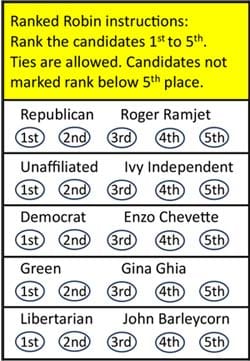
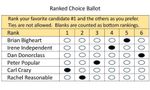
In a race between Amy, Bob and Carol, the ballots should show each voter’s preference for each pair of candidates: Amy vs. Bob, Amy vs. Carol, and Bob vs. Carol. For this, we need ranked or rated ballots. A ranked ballot with instructions is shown above. We discuss rated voting methods on the Score voting page.
Ranked Robin Voting Methods
Ranked Robin[1] is a new name for voting methods that conduct a round robin tournament with one-on-one contests between each pair of candidates. The candidate with the best record wins. Ties are discussed below. Ranked Robin[2] voting is also known as Round Robin and Tournament voting.
Ranked Robin Basics
You rank the candidates on your ballot (above) from 1st to last. In most cases, ties are allowed. An unranked candidate is ranked below all the ranked candidates on your ballot. You can diss a candidate by leaving their line blank.
If you rank John Barleycorn 2nd and Roger Ramjet 4th, your vote goes to John when they meet in the tournament. If you rank them equal your vote does not affect their contest. If you rank Roger 4th and do not rank John, your vote goes to Roger.
These rules encourage voters to study and rank all the candidates.
Ranked Robin ballots should have at least as many ranks as candidates. Extra ranks would let voters express their opinions on each candidate with more precision.
Condorcet Fairness and Reliability
Ranked Robin elects the candidate who beats all the others one-on-one (if one exists). As the number of voters increases, elections without a “beats all” winner become rare.
Voting methods that elect the “beats all” candidate (if there is one) are known as Condorcet methods. They were popularized by Nicolas Caritat, the Marquis de Condorcet, in the late 18th century. The “beats all” concept was proposed by Ramon Llull in 1299.
Condorcet voting methods are fair and reliable. We know what they will do. Plurality voting has problems in every race with three or more candidates. Ranked Choice Voting (RCV) has occasional spoilers due to the capricious way some second-choice votes are counted and some are not.
Ties and Tiebreakers
Should a tie in a tournament contest potentially alter the final outcome, a recount will be required. While uncommon, such ties occur more often in plurality elections with the same number of voters. Legislation enacting Ranked Robin will need to set rules for ties and recounts.
More common are ties in the tournament standings. If the two top candidates have equal records, the tied candidate who beat the other tied candidate in the tournament is elected (a different rule could be used).
Condorcet Tiebreakers
Each Ranked Robin voting method has a different way of breaking ties between three or more candidates. These ties are called Condorcet cycles. Candidate A beats Candidate B, who beats Candidate C, but Candidate C beats Candidate A (A>B>C>A). We list a few notable tiebreakers here.
Favorite Tiebreaker
Elect the tied candidate who is top-ranked on the most ballots. This elects the plurality winner except in a very weird election where the plurality winner was not one of the tied candidates.
Plurality Winner
Elect the plurality winner even if they were not one of the tied candidates. The plurality winner is the candidate top-ranked on the most ballots.
Smallest Margin Method
In a three-way tie, each tied candidate has one loss (in rare cases they have two losses). Elect the tied candidate who lost by the smallest margin. This is the candidate who came closest to winning one more match. That win would have won the tournament by avoiding the tie.
Put differently, elect the candidate who came closest to a Condorcet win. In the rare case where tied candidates have two or more losses, elect the candidate closest to having one less loss than the other tied candidates. This method is also known as the “Most Wins, Smallest Loss Tiebreaker” and the “Smith/Minimax Tiebreaker”.
Preference Votes Tiebreaker
Elect the tied candidate who won the most matches against the other tied candidates on the voters’ ballots.
Example: Candidates Amy, Bob, and Carol are tied. From the tournament contests: Amy vs Bob, Amy vs Carol, and Bob vs Carol, elect the candidate with the most wins on the ballots of all voters. Every voter has a vote in all three contests.
Win Margin Tiebreaker
Elect the tied candidate who has the largest win margin in tournament contests against the other tied candidates.
To find a tied candidate’s win margin, add up all their wins against the other tied candidates on each voter’s ballot. Next, subtract the losses in those contests. The candidate with the largest margin wins.
Black
Elect the candidate with the highest Borda score or elect the tied candidate with the highest Borda score.
To determine a candidate’s Borda Score count the wins that candidate has over the other candidates. If your rank Candidate A 1st, Candidate B 2nd, Candidate C 3rd, and Candidate D 4th on your ballot; Candidate A wins 3 points by beating B, C, & D, Candidate B wins 2 points by beating C & D, and Candidate C wins 1 point by beating D. Candidate D does not win points. All ballots are counted in this manner.
State Constitutional Compliance
The Ranked Robin tournament has a strong argument in support of its compliance with the forty state constitutions that require election winners to have the “highest, “greatest”, “largest” number of votes or a plurality of the votes.
Every voter has an equal vote in each tournament contest. A candidate wins each one-on-one tournament contest with a majority of the votes. The candidate who wins the most contests is elected. Every preference expressed by every voter is used in the round robin tournament.
If the Ranked Robin tournament does not pass constitutional muster; a state constitutional amendment will be required to enact Ranked Robin voting.
The tie-breaking method must comply with the state constitution. The Plurality Winner tiebreaker is the safest bet. The Preference Votes tiebreaker is also a good bet.
Alternatives
STAR voting and BTR-Score are top shelf voting methods that have strong arguments for state constitutional compliance.
Voters Win
By ranking the candidates, we can express our opinion about every candidate. Ranked Robin methods will always elect the “beats all” Condorcet winner if there is one. We recommend Ranked Robin because it is fair to all candidates, parties and voters.
The Equal Vote Coalition coined the term “Ranked Robin” in 2021. ↩︎
Ranked Robin Voting Electowiki - Tournament Elections With Round-Robin Primaries: A Sports Analogy for Electoral Reform Edward B. Foley ↩︎
Members Discussion
Featured Articles

Consensus Choice Voting System
Apr 16, 2026

Top Four and Final Five Blanket Primaries
Apr 08, 2026

Eliminate Citizens United
Apr 05, 2026

How the Billionaire Coalition Wins
Mar 24, 2026

Authoritarianism is an Orgy of Butt Kissing
Feb 18, 2026

The Voters’ Army 2026 Goals
Dec 16, 2025


The Second Law of Economics
Dec 02, 2025

Chinese Style Surveillance in America
Dec 01, 2025

A Graduated Corporate Tax to Increase Competition
Nov 29, 2025
BTR-Score Voting
Oct 16, 2025
Approval Voting and Combined Approval Voting
Oct 14, 2025

NOPWSIcare - Great Healthcare & More Jobs
Sep 01, 2025


The Tax Code Is a Con and You're the Mark
Aug 25, 2025

Plurality Voting Pros and Cons
Aug 20, 2025

Why America Needs Proportional Representation
Aug 16, 2025

Building Capitalism for the People
Jul 13, 2025

When America Was Great
Jul 12, 2025